Volume XXVII, No. 18 (No. 717)
Friday, February 13, 2026
A Biweekly Electronic Newsletter
As a public service, Hurwitz Fine P.C. is pleased to present its biweekly newsletter, providing summaries of and access to the latest insurance law decisions from the New York, New Jersey, and Connecticut appellate courts and Canadian appellate courts. The primary purpose of this newsletter is to provide timely educational information and commentary for our clients and subscribers.
In some jurisdictions, newsletters such as this may be considered Attorney Advertising.
If you know of others who may wish to subscribe to this free publication, or if you wish to discontinue your subscription, please advise Dan D. Kohane at [email protected] or call 716-849-8900.
You will find back issues of Coverage Pointers on the firm website listed above.

Dear Coverage Pointers Subscribers:
Do you have a situation? We love situations. Happy Valentine’s Day.
Greetings from Scottsdale. It’s much easier to work from here, where my only concern is sunburn.
I am celebrating my 46th anniversary as a lawyer (on Thursday 2/12), all of them with Hurwitz Fine (plus 2 ? years as a clerk). When I joined the firm as a clerk, then Hurwitz & Fine, P.C. was 45 days old, and had a local, parochial insurance defense and transaction purpose. We’ve grown a bit since then. We now have 65 lawyers and with the new additions, 17 on our Coverage Team. Read all about it.
Hurwitz Fine Further Expands Northeast Presence with the Hiring of
Three New England Insurance Coverage Partners and
Massachusetts and New Hampshire Office Openings
Hurwitz Fine P.C. is proud to announce the continued expansion of its Northeast presence with the addition of three seasoned insurance coverage partners and the opening of new offices in the Boston, MA area and in Concord, NH. This strategic growth strengthens the firm’s Insurance Coverage practice and enhances its ability to serve insurers and reinsurers throughout New England, including Connecticut, Massachusetts, New Hampshire, Rhode Island, and Vermont.
With a longstanding reputation for excellence in insurance coverage, litigation defense, and business services, Hurwitz Fine’s expanded New England presence demonstrates the firm’s ongoing commitment to serving the evolving needs of its clients throughout the region.
The New England Insurance Coverage team includes:
- Barbara A. O’Donnell – Barbara brings more than 30 years of experience advising insurers on complex insurance coverage disputes and bad-faith claims. Admitted to practice in state and federal courts in Massachusetts, Connecticut, and New York, she has a strong record of successfully handling defective construction, additional insured, priority of coverage, allocation, and unfair claims handling matters across the Northeast. A leader within the Federation of Defense and Corporate Counsel and the American College of Coverage and Extracontractual Counsel, Barbara regularly advises insurers on proactive strategies to minimize extra-contractual exposure and emerging coverage issues, including through customized client presentations. She has served on the faculty of the FDCC Insurance Coverage Training Academy Boot Camp, authored numerous articles on coverage and claims handling topics, and is admitted to practice before the U.S. Court of Appeals for the First Circuit.
- Alexander G. Henlin – Alex brings more than 20 years of experience counseling and representing insurers and reinsurers in arbitration, litigation, and alternative dispute forums throughout New England and the broader Northeast. He has served as lead counsel at both the trial and appellate levels, advising on complex insurance coverage and bad-faith matters involving primary and excess-layer programs, first- and third-party risks, and policies including general liability, D&O, E&O, and professional liability, as well as emerging risks. He regularly guides cedants and reinsurers in facultative and treaty arbitrations and advises on rights and responsibilities across reinsurance relationships, while also defending consumer financial claims against lenders and loan servicers. A Fellow of the American College of Coverage Counsel, Alex serves as co-chair of its Educational Dialogues Committee and is Vice Chair of the Insurance & Reinsurance Committee of the International Association of Defense Counsel. He is a frequent conference organizer and CLE presenter, active in state and national bar organizations, and is admitted to practice in Massachusetts, New Hampshire, New Jersey, New York, Rhode Island, and Vermont.
- Iryna N. Dore – Iryna brings more than 15 years of experience representing insurers in insurance coverage and extra-contractual liability litigation. She counsels insurers on first- and third-party claims involving a wide range of policies, including general liability, property, auto, D&O, and professional liability, and regularly assists with the evaluation, negotiation, and litigation of complex coverage disputes and bad-faith claims. Iryna is active in national and regional bar organizations, serving as Vice Chair of the ABA Insurance Coverage Litigation General Committee and Vice Chair of the New Hampshire Bar Association’s Insurance Law Section, and is admitted to practice in New Hampshire and Massachusetts, as well as the U.S. District Courts for the Districts of New Hampshire and Massachusetts.
Hurwitz Fine has maintained an Insurance Coverage and Litigation practice in Connecticut for nearly a decade with Attorney Lee S. Siegel. The addition of permanent offices in the Boston area and Concord, along with an expanded New England team, represents a significant investment in the region and a natural extension of the firm’s growing Northeast practice.
“Our clients are increasingly looking for experienced insurance coverage counsel with regional knowledge and national reach,” said Jody E. Briandi, President & Managing Partner of Hurwitz Fine P.C. “This expansion enhances our ability to serve insurers and reinsurers across New England while maintaining the level of counsel and responsiveness our clients value.”
Hurwitz Fine P.C. remains committed to providing innovative legal solutions and trusted counsel to clients throughout the Northeast and beyond, and this expansion marks another important chapter in the firm’s continued growth. Most recently, in 2025, the firm expanded with the opening of a Rochester office and dedicated litigation team located there.
Coverage Pointers University
Registration is Open for our Third Program
The instructor is the King of SUM Coverage, our own Ryan O’Shea
Summing up “SUM” Coverage: A Primer on Addressing a Demand for New York Supplementary Uninsured/Underinsured Motorist Benefit

Thursday, February 19, 2026 | 1:00 PM Eastern
Join Insurance Coverage attorney Ryan P. O’Shea for a practical webinar covering the fundamentals of NY Supplementary Uninsured/Underinsured Motorist (SUM) coverage. This presentation will address what SUM coverage is, its historical background, and when it applies. The session will also explore the most common issues that arise in SUM claims, including insured status, offsets, and priority of coverage disputes. Finally, the program will walk through how SUM claims typically proceed into litigation or arbitration, providing insight into what to expect and how to navigate these matters effectively in NY.
If you are not comfortable with triggers, offsets, and consents, if you are confused about the difference between mandatory UM coverage and optional SUM coverage. If you are not aware of the 20-day rule? and the consequences of not moving for a stay, this program is for you.
TORT REFORM IN THE EMPIRE STATE
Join in on the discussion of these important proposals
New York's Governor Kathy Hochul’s 2026 Budget includes what many in the defense and insurance communities would characterize as long-overdue tort reform targeting fraud, inflated claims, and litigation abuse in motor vehicle cases.
Among the key proposals:
- Elimination of the controversial 90/180-day “serious injury” category, long criticized as a vehicle for marginal threshold claims.
- A procedural fix to resolve the split among the Departments by requiring that liability be established before a jury reaches the serious injury threshold, potentially streamlining trials and reducing unnecessary expense.
- Limits on non-economic (pain and suffering) damages for individuals operating stolen or uninsured vehicles, driving while intoxicated (if convicted), or committing crimes while using a vehicle.
- A bar on recovery where the plaintiff is more than 50% responsible for the accident.
- Repeal of CPLR ? 1602(6), eliminating joint and several liability in auto accident cases.
If enacted, these changes would significantly reshape New York motor vehicle litigation.
Telling Courts “No”: Personal Jurisdiction Defenses in High-Stakes Litigation
Tuesday, February 24,, 2026
12:00pm - 1:00pm
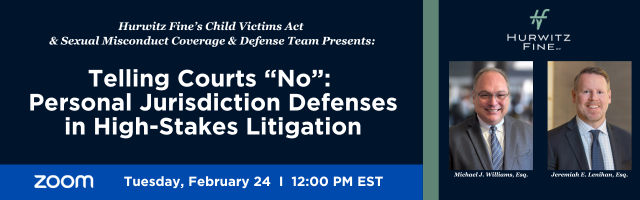
Join Hurwitz Fine’s Child Victims Act & Sexual Misconduct Coverage & Defense Team—Michael J. Williams and Jeremiah E. Lenihan—for a webinar exploring one of the most critical defenses available to clients with national and international reach: general and specific personal jurisdiction.
The Supreme Court of the United States has spent the last 15 years evolving these doctrines in a manner respecting defendants’ due process rights while state case law myopically focuses on its own long-arm statutes. This discussion explores how Mike and Jerry have used these doctrines nationally and internationally to defend nonprofit organizations, religious institutions, retail giants, and foreign corporations including those of sovereign Native nations. Attendees will learn how to identify their opportunities to raise this surprisingly expansive defense, compel plaintiffs to proceed in a chosen and more defense-advantageous venue, avoid the costs and disclosures of discovery, and incentivize dismissal or economical resolution.
For more information, and to register, click here.
For those who need to keep up to date on insurance coverage between issues of Coverage Pointers, we’re happy to help. Just follow me on LinkedIn and we’ll keep you up to date. I’m easy to find – my linked in name is (ready for this unusual and unexpected name): Kohane and you can find me here: https://www.linkedin.com/in/kohane/
Need a Mediator or Arbitrator, Give a Call:
A growing percentage of my practice has been a mediator (and sometimes as an arbitrator) in insurance coverage, commercial, personal injury, and other disputes. With a robust national client base, I am regularly called on by friends and colleagues from around the country, folks who know me and trust me, to help resolve disputes. Often, particularly in mediated matters, I know the insurers and lawyers on both (or several) sides of the dispute. Since they all trust me as a fair dealer, they feel comfortable having me try to help close the file (and avoid precedent). Just pick up the phone, 716.849.8942 or send an email to [email protected] and I’ll try to help.
Newsletters:
We have other firm newsletters to which you can subscribe by simply letting the editor (or me) know, including a new publication, which was created to advise on business and employment law questions:
- Premises Pointers: This monthly electronic newsletter covers current cases, trends and developments involving premises liability and general litigation. Our attorneys must stay abreast of new cases and trends across New York in both State and Federal Court and will now share their insight and analysis with you. This publication covers a wide range of topics including retail, restaurant and hospitality liability, slip and fall accidents, snow and ice claims, storm in progress, inadequate/negligent security, inadequate maintenance and negligent repair, service contracts, elevator and escalator accidents, swimming pool and recreational accidents, negligent supervision, assumption of risk, tavern owner and dram shop liability, homeowner liability and toxic exposures (just to name a few!). Please drop a note to Jody Briandi at [email protected] to be added to the mailing list.
- Labor Law Pointers: Hurwitz Fine P.C.’s Labor Law Pointers offers a monthly review and analysis of every New York State Labor Law case decided during the month by the Court of Appeals and all four Departments. This e-mail direct newsletter is published the first Wednesday of each month on four distinct areas – New York Labor Law Sections 240(1), 241(6), 200 and indemnity/risk transfer. Contact Dave Adams at [email protected] to subscribe.
- Products Liability Pointers: Whether the claim is based on a defective design, flawed manufacturing process, or inadequate instructions/warnings, product liability litigation is constantly evolving. Products Liability Pointers examines recent New York State and Federal cases as well as high court decisions from other jurisdictions, keeping our readers up to date with the latest developments and trends, and providing useful practice tips and litigation strategies. This monthly newsletter covers all areas of product liability litigation, including negligence, strict products liability, breach of warranty claims, medical device litigation, toxic and mass torts, regulatory framework and governmental agencies. Contact V. Christopher Potenza at [email protected] to subscribe.
- Medical & Nursing Home Liability Pointers. Medical & Nursing Home Liability Pointers provides the latest news, developments, and analysis of recent court decisions impacting the medical and long-term care communities. Contact Elizabeth Midgley at [email protected] to subscribe.
Some Things Never Change – 100 Years Ago:
San Francisco Bulletin
San Francisco, California
13 Feb 1926
Many Buy Tokens
For Valentine’s Day
Tomorrow is St. Valentine’s Day and, according to Dame Custom, the time when hopeful Romeos may, without embarrassment, shout loud and long anent love for the feminine objects of their devotion. And vice versa.
It is the day when fond missives of affection, emblazoned with crimson hearts, fill the city’s mailboxes, announcing to their recipients that a feeling on undying devotion lies smoldering in the heart of the sender.
Or, if your feelings have a different trend, it is the time when you may announce yourself through the medium of the comic valentine. Experience has taught many that it is not always good policy to affix one’s signature to messages of the latter disposition, however.
Contrary to current rumors that the Valentine Day spirit is nearing oblivion, local stationers, florists and confectioners report heavy sales in their respective lines. All of which indicates that San Francisco will resound with an over-abundance of bliss on the morrow.
Peiper on Property (and Potpourri):
Just back from connecting with folks from around the country at IADC’s Mid-Year meeting in New Orleans. It was nice to hear some great presentations, and sneak in a little bit of sunshine along the way. With a shout out to Bubba from Forest Gump, there are, indeed, many ways to prepare shrimp. After four days in New Orleans, I am convinced there are just as many to prepare oysters. And both are delicious.
As outlined above, we do hope you continue to take advantage of our webinar series. Ryan O’Shea is up next week on a really useful update of New York State Uninsured/Underinsured Motorists coverage. Check it out.
And, on top of it, we at Coverage Pointers University are delighted to see that our friends in the litigation department also have some top-notch webinar offerings this month. Perhaps we have our first satellite campus in the works. Can’t wait to see the US News and World Report on which campus has the tougher admission standards, and which provides the best value.
That’s it for this week. See you in two more.
Steve
Steven E. Peiper
[email protected]
Shake, Rattle, and Roll – 100 Years Ago:
Blackwell Journal-Tribune
Blackwell, Oklahoma
13 Feb 1926
TO RECORD
QUAKES TEN
YEARS AHEAD
New Instrument To Make
Advance Predictions
Possible
PASADENA, Cal., Feb. 12. – Prediction of earthquakes as far as ten years ahead of their occurrence will soon be possible.
Starting results being obtained here in investigations with a recently invented seismograph will enable scientists to correctly forecast earth shocks, Dr. John P. Bulwalda of the California Institute of Technology declared.
With Dr. Harry Wood and Dr. J. A. Anderson of the Carnegie Institute. Inventors of the new seismograph, Dr. Bulwalda, who assisted in perfecting the instrument for recording the earth’s shock, is carrying on investigations which promise accurate advance predictions on earthquakes.
Lee’s Connecticut Chronicles:
Dear Nutmeggers,
The Connecticut office is very excited about the addition of our new New England colleagues to the Firm. Expanding ever eastward, our resources and ability to serve our clients in Connecticut and throughout New England continues to grow.
We look forward to working with you from the northern reaches of Maine to the shoreline of Connecticut and everywhere in between.
Until next edition, keep keeping warm!
Lee
Lee S. Siegel
[email protected]
Off by a Little – The Population of Florida in 1940 was 1,897,414. Now, it’s About 21 Million – 100 Years Ago:
Tampa Bay Times
St. Petersburg, Florida
13 Feb 1926
FLORIDA WILL
RIVAL ITALY,
LATHAM SAYS
Five Million Population in
Five Years, Declares
Power President
That Florida will have a population nearly as large as that now credited to Italy, within the next 15 years, was the startling prediction made by B.M. Latham, president of the Pinellas County Power and Light company, at a meeting of Eaglecrest Development company salesmen held in the 470 Central avenue offices of that organization, Friday evening.
“Florida will accumulate 5,000,000 permanent residents within three years,” predicted Latham, “and that number will be increased to 30,000,000 by 1940.”
Latham’s prediction came at the close of a 30-minute talk he gave on the state of Florida.
A Fool for a Client – 100 Years Ago:
The Buffalo Times
Buffalo, New York
13 Feb 1926
Lawyer, Own Counsel,
Loses Wife by Decree
BRIGDEPORT, Feb, 13. – Walter Eastland, attorney of New York City, acted as his own counsel before Judge Wolfe in Superior court in his wife’s divorce action.
Mrs. Eastland, a resident of Stamford, was given a divorce and permission to resume her name, Emma Luther.
Eastland denied his wife’s charges that he called children “pests” and that he threatened to take her life to save himself from fatherhood.
Ryan’s Federal Reporter:
Hello Loyal Coverage Pointers Subscribers:
My favorite past-time every four years is to binge U.S. Curling during the Winter Olympics, and this year is no exception. The U.S. Mixed Doubles team has already brought hardware home with them and there are high hopes for the remaining categories (at least from my perspective). A new U.S. Men’s team represents the red, white, and blue this year and it would be truly amazing if they could repeat the 2018 Gold Medal run that John Shuster’s team accomplished the first year after passing the torch. We shall see…
This edition, my column includes a mortgage lending case involving a class action fee dispute and an insured’s derivative liability under the Home Ownership and Equity Protection Act (it was quite the power play). Did the mortgage borrowers draw one to the button or flash it through the house? Those are curling puns; I couldn’t help myself.
Until next time,
Ryan
Ryan P. Maxwell
[email protected]
Is That a Crime? – 100 Years Ago:
The Buffalo News
Buffalo, New York
13 Feb 1926
BERGDOLL ARRESTED
OVER LOVE AFFAIRS
Draft Dodger Who Fled U.S.,
Finds Trouble in Baden.
MOSBACH, Baden, Feb. 13. – Grover Cleveland Bergdoll, Philadelphia draft evader, who since a sensational escape has evaded efforts to return him to the United States, is under arrest here.
He was taken into custody yesterday on allegations involving love affairs.
Storm’s SIU:
Hi Team:
Busy, busy week so only one case digest this edition:
- Court Upheld Subpoenas to Non-Parties Who Allegedly Participated in a Fraud Scheme by Referring the Plaintiff to Counsel, Providing Litigation Funding, and Receiving Payments From that Funding
I hope you have a great two weeks until the next edition. We always appreciate the opportunity to work with you!
Scott
Scott D. Storm
[email protected]
National Coal Strike Caused Grief. It was Settled a Day Earlier – 100 Years Ago:
The Buffalo News
Buffalo, New York
13 Feb 1926
SCORES INJURED
IN N.Y. FUEL RIOT
NEW YORK, Feb. 13. – A riot call for police was sent out today when hundreds of men, women, and children, seeking fuel, stormed the coke yards of the Consolidated Gas company in First avenue at 110th street. Scores were injured in the melee before the police could quell the disturbance.
Fleming’s Finest:
Hi Coverage Pointers Subscribers:
It is finally warming up a little just in time for Galentine’s/Valentine’s Day. Looking forward to spending some time outside this weekend! Hope you have a great week.
This edition’s case from the Maine Supreme Judicial Court considered whether an insurer has to send a notice of nonrenewal prior to the termination of an insurance policy at its expiration date if the insurer had offered to renew the policy, but the insured did not take any steps to renew it.
See you in a fortnight,
Kate
Katherine A. Fleming
[email protected]
Would Make Dagwood Happy – 100 Years Ago:
The Chat
Brooklyn, New York
13 Feb 1926
Bumsteads Worm Syrup
“To children an angel of mercy.” Where directions are followed, it NEVER FAILS. Despite scarcity and enormous cost of SANTONIN, it contains full dose. Stood sixty years’ test. Sold everywhere or by mail, 50c a bottle. Est. C. A. Voorhees, M.D., Philadelphia.
Gestwick’s Garden State Gazette:
Dear Readers:
With the Olympics in full swing, there is hardly much else about which to speak, other than the message my fiance and I received from our jeweler today, letting us know that our wedding bands are in for sizing! We are going on Saturday, Valentine’s Day, to try them on.
I have two cases this week. The first has to do with a coverage action arising out of an underlying labor law action. The insurer for one of the contractors sued the insurer for the subcontractor, seeking declarations that the latter had a duty to defend and indemnify the former’s insured (and a few other tendering parties), reimburse for past defense costs, and indemnify the tendering parties. The relevant trade contract required the subcontractor to procure and maintain CGL coverage naming the tendering parties as additional insureds; the subcontract complied with this by procuring exactly that coverage; the additional insured endorsement included blanket coverage for additional insured where required by written contract or agreement, for bodily injury caused in whole or in part by the subcontractor’s work; and there were pleadings to the effect that the plaintiff’s injuries were caused in whole or in part by the subcontractor. The issues of duty to defend and reimbursement were easy-peasy. But there was not yet an indemnifiable loss—what to do about that pesky indemnity claim, then? Read on to find out.
In the second case, a man was involved in an auto accident using his girlfriend’s car. He qualified as an insured on her auto policy as a permissive user, but not as the named insured, their spouse/civil partner, or resident relative. The boyfriend recovered the tortfeasor’s limit and sought coverage from the girlfriend’s insurer’s uninsured motorist limit. Was he entitled to the full UIM limit, the state minimum UIM limit, or nothing at all?
That’s it for this week. See you in two more. Until next time, stay warm.
Evan
Evan D. Gestwick
[email protected]
Can Reprint Today– 100 Years Ago:
The Buffalo News
Buffalo, New York
13 Feb 1926
When Mortgaged House Burns
Editor Evening News:
I am puzzled about something, so I am asking our column to help me. A house is mortgaged and it is insured, the mortgagee holding the insurance policy, as is the custom. Now, if the house burns, to whom does the insurance money go? Does the man who holds the mortgage take all, or only enough to make good the amount of the mortgage? Riverside Ave. Puzzled.
Our legal department replies as follows: In the event that a place is destroyed by fire, if the mortgagee holds the policy in which an agreement makes him the payee or beneficiary of the policy, he receives the money and retains such amount as his mortgage calls for. The owner of the premises receives the balance over the above the amount of the mortgage.
O’Shea Rides the Circuits:
Readers:
Not much going on in my neck of the woods other than working in an office adorned in a pink aesthetic. Shoutout to Lexi Horton for the colorful workspace.
This week I have a priority of coverage case from the Seventh Circuit dealing with Motor Carrier coverage. Essentially a trailer lease containing liability carve language failed to meet the definition of an “insured contract;” and the court deferred to George Orwell to reject an “all excess clauses are excess, but some are more excess than others” super excess argument, where the lease lacked specific priority obligations.
Until Next Time,
Ryan
Ryan P. O’Shea
[email protected]
Racism 100 Years Ago – the Address Now Houses a Thai Restaurant – 100 Years Ago:
Evening Star
Washington, District of Columbia
13 Feb 1926
THEARLE. 2122 P ST. N.W. NEAR Dupont Circle – six rooms and bath, rear porch, Apt. 31: well-arranged large outside rooms. Splendid condition; plenty heat and hot water: strictly white neighborhood: adults: reduced rent.
LaBarbera’s Lower Court Library:
Dear Readers:
This week we discussed an interesting case out of Kings County, finding that the Covenant Not to Execute and Release in the Underlying Action precluded any right of recovery from the plaintiff for indemnity from the underlying tortfeasor’s insurance carrier. Further, the court discusses how the late notice provided to the carrier resulted in material prejudice.
Until next time…
Isabelle
Isabelle H. LaBarbera
[email protected]
Judges Charged – 100 Years Ago:
Poughkeepsie Eagle-News
Poughkeepsie, New York
13 Feb 1926
JUSTICES ORDERED
TO RETURN $407.25
Morschauser Rules No Fees Should
Have Been Collected on Blanks
For Entering Court Verdicts
The first direct action taken toward straightening out the tangled finances of the town of Poughkeepsie was taken Friday morning when Justice Joseph Morschauser ordered the justices of the peace to return $407.25 to the town. This item in the examiners’ report was upheld by the court, but several alleged overcharges were quashed in the course of the hearing that occupied the entire morning session.
The blanks on which the justices of the peace have charged fees for entering verdicts are arranged to say, “for entering verdict of court-jury.” And the justices mark which verdict they are entering, whether of the court or of a jury. Justice Morschauser held that the charge for entering a jury verdict is legal but that no fee should be charged for entering the verdict of the court.
Lexi’s Legislative Lowdown:
Dear Readers,
A tradition that started with my best friend in college, heart-shaped pizza on Valentine’s Day. Luckily, my fiance is fully on board, and we’ve kept it going every year. This year marks year four. Even though my best friend has since moved to Charlotte, the tradition lives on.
This week we discuss a portion of the Governor’s 2027 Executive Budget addressing the serious injury threshold and non-economic loss.
Thanks for reading,
Lexi
Lexi R. Horton
[email protected]
Good Advice – 100 Years Ago:
Birmingham Post-Herald
Birmingham, Alabama
13 Feb 1926
DRUNK FOR 10 YEARS
A.C.L. writes: I have been drunk for 10 years and getting drunker all the time; how can I quit it, and if I don’t how long can I live? Married man of 34.
REPLY
Go to an institution and take a cure. After the cure stay in the institution long enough to build up your nervous system.
Then spend a few years training your character.
At present, you are just a poor, weak fish.
Victoria’s Vision on Bad Faith
Dear Readers,
I hope February has been treating you well. While Punxsutawney Phil and Buffalo Bert may have seen their shadows, we still have Valentine's Day and, more importantly, Galentine's Day this week. That, the Seahawks win, and the sun is still out (albeit not much) on my drive home from work.
New York courts have been quiet on bad faith, so this week I have a case from the District Court of Arizona discussing the insurer's settlement offers compared to arbitration findings.
Have a good weekend,
Victoria
Victoria S. Heist
[email protected]
Advice to Girls – Take Note! – 100 Years Ago:
East Oregonian
Pendleton, Oregon
13 Feb 1926
Advice to Girls
By Annie Laurie
DEAR ANNIE LAURIE:
I am in love with a young man. About two weeks ago he asked me to kiss him, but I did not. Now he won’t speak to me. Please advise me what to do. WEEPING.
WEEPING: Don’t cry over this young man, my dear. If he insists that you violate the conventions in order to keep his friendship, he isn’t worth your worry. Go about with your friends and wait until this young man “gets over it.” And if he doesn’t – cross his name from your list of friends.
__________
DEAR ANNIE LAURIE:
I am a girl in my early teens and am very much interested in a young man about two years my senior. I have known him only a few months, but he has never asked to call upon me.
I would like very much to have his company so please advise me what to do. BLUE EYES.
BLUE EYES: Why don’t you invite this young man to call on you, Miss Blue Eyes? If you have tastes and interests in common you will probably spend a very enjoyable evening together – and he will want to come again and again.
Editor’s Note: Winifred Sweet Black Bonfils (October 14, 1863, Chilton, Wisconsin – May 25, 1936, San Francisco, California) was an American reporter and columnist, under the pen name Annie Laurie, a reference to her mother's favorite lullaby. She also wrote under the name Winifred Black. Best I can tell, her columns appeared in newspapers through from 1912 to April 1930.
Shim’s Serious Injury Segment
Hi Readers,
Hope everyone enjoyed the Super Bowl. Congratulations to the Seattle Seahawks on securing their second Lombardi Trophy and getting revenge against the Patriots this time around. It’s finally time to gear up for Spring Training and usher in more mild weather as we welcome back America’s national pastime. I’m very excited for baseball.
This week we’re giving our very own, Brian M. Webb, Esq., a shoutout (or as we like to call it, an "atta lawyer") for his recent success on a cross-motion for summary judgment and oral argument, affirmed by the Appellate Division, Fourth Department, dismissing plaintiff’s complaint on grounds that plaintiff did not sustain a serious injury within the meaning of Insurance Law ? 5102(d). It is my pleasure to have shared a case in this week’s column defended by our colleague and dear friend, Brian Webb.
See you in the next issue!
Stephen
Stephen M. Shimshi
[email protected]
Radio May Make It! – 100 Years Ago:
The Chicago Defender
Chicago, Illinois
13 Feb 1926
Radio Grows Rapidly
Radio interest in this country is still growing by leaps and bounds. Predictions that the tremendous public enthusiasm over the new national “plaything” that showed itself during the year 1925 would play itself out during the year 1926 have already fallen flat. Buying of radio equipment and installation of radio sets, instead of declining is growing at a rapid rate.
North of the Border:
February has been heartbreaking across Western Canada. In southern Alberta, three Junior A players with the Southern Alberta Mustangs died when their car was hit by a loaded gravel truck when they were on their way to a team practice, leaving a small Alberta town and the wider hockey community shattered.
Further west, the quiet community of Tumbler Ridge, British Columbia, has been forced to confront the unthinkable in the wake of what is now known as Canada’s deadliest school shooting which claimed the lives of students, an educator, and the family members of the shooter.
Against this backdrop of grief, we watch Olympic athletes push the limits of what the human body and spirit can do, embodying diligence, perseverance and the power of daring to pursue one’s dreams.
It is hard to celebrate that excellence while mourning young lives cut short, yet perhaps the only honest place to stand this month is in that tension: Honouring the dreams these teenagers will never fulfill, even as we let the courage and commitment of all our athletes remind us of the value of every young life, and of the communities that rally both when everything is on the line and when tragedy too big to define hits home.
My article this week discusses a seminal Supreme Court of Canada case that was released January 30.
Heather
Heather A. Sanderson, K.C.
Sanderson Law
Calgary, Alberta, Canada
[email protected]
Headlines from this week’s issue, attached:
KOHANE’S COVERAGE CORNER
Dan D. Kohane
[email protected]
- A Policy That Insures Against Losses Arising From Operations Necessary or Incidental to a Premises Did Not Provide Coverage for a Bicycle Delivery Accident a Block Away From a Restaurant
- A Certificate of Insurance Does Not Create Coverage and, in Any Event, a CGL Policy Does Not Cover Property Damage to the Named Insured’s Property
- Unless an Additional Insured Endorsement Requires an Agreement to Be Signed, It Need Not Be Signed, as Long as the Parties Intended It to Be Effective
PEIPER on PROPERTY (and POTPOURRI)
Steven E. Peiper
[email protected]
- Common Law Indemnity Requires a Showing That Movant Was Not Negligent, and the Target Indemnitor Was Negligent
- Section 5-321 Does Not Categorically Void Indemnity Clauses Which Consider Protection for the Owner’s Own Negligence
LEE’S CONNECTICUT CHRONICLES
Lee S. Siegel
[email protected]
- Insurer Owes Injured Third-Party Plaintiff No Duty
RYAN’S FEDERAL REPORTER
Ryan P. Maxwell
[email protected]
- Class of Mortgage Borrowers Unable to Recover Settlement Proceeds From Lender’s Insurers Due to Application of Fee Exclusion
STORM’S SIU
Scott D. Storm
[email protected]
- Court Upheld Subpoenas to Non-Parties Who Allegedly Participated in a Fraud Scheme by Referring the Plaintiff to Counsel, Providing Litigation Funding, and Receiving Payments From That Funding
FLEMING’S FINEST
Katherine A. Fleming
[email protected]
- Offer to Renew Insurance Policy Does Not Relieve Insurer of the Obligation to Send a Notice of Nonrenewal Prior to Termination at Expiration Date
GESTWICK’S GARDEN STATE GAZETTE
Evan D. Gestwick
[email protected]
- Court Grants Judgment on Duty to Defend; Denies Judgment on Duty to Indemnity Without Prejudice Due to Lack of Ripeness
- Step-Down Provision in Uninsured Motorist Coverage Enforced, and no UIM Coverage Awarded As a Result, All Because the Policy Complied With the Regulations. Thousands Cheer
O’SHEA RIDES the CIRCUITS
Ryan P. O’Shea
[email protected]
- Interchange Agreement Did Not Qualify as “Insured Contract” Since Contract Carved Out Liability Assumed for a Third-Party
LABARBERA’S LOWER COURT LIBRARY
Isabelle H. LaBarbera
[email protected]
- Court Finds Material Prejudice Based on Late Notice, and Regardless of Notice, Holds Covenant Not to Execute and Release in Underlying Action Eliminates Insurer’s Obligation to Indemnify
LEXI’S LEGISLATIVE LOWDOWN
Lexi R. Horton
[email protected]
- Section EE of the Governor’s Executive Budget Includes Proposed Changes to Limit Non-Economic Damages Under Certain Circumstances
VICTORIA’S VISION ON BAD FAITH
Victoria S. Heist
[email protected]
- Court Finds Question of Fact for Bad Faith in Insurer Handling UM Claim
SHIM’S SERIOUS INJURY SEGMENT
Stephen M. Shimshi
[email protected]
- Appellate Division, Fourth Department, Affirms Erie County Supreme Court Decision Granting Defendant’s Cross Motion for Summary Judgment on the Basis That Plaintiff Did Not Sustain a “Serious Injury” in Accordance With Article 51 of the New York State Insurance Law
NORTH of the BORDER
Heather A. Sanderson, K.C.
Sanderson Law
Calgary, Alberta, Canada
[email protected]
- Who Pays the Cost of Flood Proofing a Home Built Within a Flood Plain?
Stay warm. Spring is coming.
Hurwitz Fine P.C. is a full-service law firm providing legal services throughout the State of New York and providing insurance coverage advice and counsel in Connecticut and New Jersey.
In addition, Dan D. Kohane is a Foreign Legal Consultant, Permit No. 0119144, issued by the Law Society of Upper Canada, and authorized to provide legal advice in the Province of Ontario on matters of New York State and federal law.
NEWSLETTER EDITOR
Dan D. Kohane
[email protected]
ASSOCIATE EDITOR
Evan D. Gestwick
[email protected]
INSURANCE COVERAGE/EXTRA CONTRACTUAL LIABILITY TEAM
Dan D. Kohane, Chair
[email protected]
Steven E. Peiper, Co-Chair
[email protected]
Michael F. Perley
Agnieszka A. Wilewicz
Lee S. Siegel
Brian F. Mark
Scott D. Storm
Ryan P. Maxwell
Katherine A. Fleming
Evan D. Gestwick
Ryan P. O’Shea
Isabelle H. LaBarbera
Lexi R. Horton
Victoria S. Heist
FIRE, FIRST PARTY AND SUBROGATION TEAM
Steven E. Peiper, Team Leader
[email protected]
Michael F. Perley
Scott D. Storm
NO-FAULT/UM/SUM TEAM
Dan D. Kohane
[email protected]
Ryan P. O’Shea
[email protected]
APPELLATE TEAM
Jody E. Briandi, Team Leader
[email protected]
Topical Index
Peiper on Property and Potpourri
Lee’s Connecticut Chronicles
Gestwick’s Garden State Gazette
LaBarbera’s Lower Court Library
Lexi’s Legislative Lowdown
Victoria’s Vision on Bad Faith
KOHANE’S COVERAGE CORNER
Dan D. Kohane
[email protected]
02/11/26 Normille v. DB Ins. Co, Ltd
Appellate Division, Second Department
A Policy that Insures Against Losses Arising From Operations Necessary or Incidental to a Premises Did Not Provide Coverage for a Bicycle Delivery Accident a Block Away From a Restaurant
The primary issue on appeal is whether the language of the subject general liability business insurance policy obligates the insurer to provide coverage for bodily injury that allegedly occurred in the course of the insured's business, but not as a result of operations at or otherwise related to the covered premises that are specifically identified in the policy. The court held that under the language of the insurance policy at issue here, the insurer was not obligated to provide coverage to the insured and, thus, is not required pursuant to Insurance Law § 3420(a)(2) to satisfy the outstanding amount of the judgment in favor of the plaintiff and against the insured in the underlying action.
The insured was doing business as Kittery Restaurant (hereinafter the insured), was operating a restaurant located in Brooklyn that included take-out food delivery services. Normile, alleges that she was injured in April 2014, when an employee of the insured, while riding a bicycle, collided with her as she was crossing the street. That employee allegedly was in the process of returning to the insured's restaurant from a food delivery when the collision occurred one city block away from the restaurant. She brought suit in 2014.
The policy contained a "Limitation of Coverage to Designated Premises or Project." endorsement which limited coverage to claims of "bodily injury, property damage, personal and advertising injury, and medical expenses arising out of . . . [t]he ownership, maintenance or use of the premises . . . and operations necessary or incidental to those premises." The policy identified the covered "premises" as 305 Union Street in Brooklyn, the apparent location of the insured's restaurant.
The insurer disclaimed coverage and refused to defend or indemnify the insured in the underlying action because, among other things, the accident did not occur at the covered premises. Plaintiff took judgment against the insured and then commenced a direct action against the carrier to recover the unsatisfied amount of the judgment.
In construing an insurance contract, the tests to be applied are common speech and the reasonable expectations of the average insured upon reading the policy
The interpretation of an insurance provision must be sensitive to the reasonable expectations of the average insured.
The plaintiff urges a finding that the actions of the insured's employee—riding a bicycle back to the restaurant after delivering a take-out order—constituted an "operation[ ] necessary or incidental to those premises." The insurer, on the other hand, maintained that the incident did not occur at the covered premises and that the language of the policy applies only to incidents that occur at the covered premises.
The court found that the plain language of the policy is not ambiguous, since there is only one meaning which may be attached to the words used therein.
While the court rejected the insurer's formalistic interpretation of the relevant language, which would allow an insurer to deny coverage any time an incident does not occur at an expressly identified covered premises, it adopted an interpretation of the policy language that requires a review of the alleged incident and its spatial and circumstantial connection to the covered premises.
Coverage must be afforded to the insured under this language where the incident takes place in a location that has a direct relationship to the covered premises and where the circumstances of the incident relate in some way to the nature of the covered premises itself, not just the business that is operating out of the covered premises.
Here, the insured's employee allegedly struck the plaintiff while riding a bicycle in the process of returning to the insured's restaurant after making a take-out food delivery. Even assuming the employee was returning to the covered premises while engaged in activity on behalf of the restaurant, the incident did not relate to the covered premises itself.
The fact that the alleged incident happened approximately one city block from the restaurant is also significant. The employee was traveling on the streets near the restaurant in order to effect deliveries, but the use of those streets was not "incidental to the use of the expressly covered premises.”
There is, the court determined a glaring difference between an insurance policy that insures against losses arising from operations necessary or incidental to a business, which would ostensibly include all claims of bodily injury arising from an employee's negligence while that employee is acting within the scope of his or her employment for the business, and a policy that insures against losses arising from operations necessary or incidental to a premises, which include claims of bodily injury that must have some premises-based connection to the covered premises.
The appellate therefore determined that the exclusion was applicable and coverage was not provided.
Editor’s Note: an atta-lawyer to both Brendan T. Fitzpatrick and Joanna M. Roberto for the win.
02/10/26 Itzhak v. Briarwood Insurance Services Inc.
Appellate Division, First Department
A Certificate of Insurance Does Not Create Coverage and, in Any Event, a CGL Policy Does Not Cover Property Damage to the Named Insured’s Property
Plaintiff alleges that her cooperative unit suffered damage during a renovation. The body of the complaint does not identify who damaged the property, the relationship among plaintiff, defendant Atlantic, and defendant Briarwood Insurance Services, Inc., or whom Atlantic or Briarwood insured. Instead, plaintiff contends that she was named as additional insured on an accord certificate of liability insurance, which she attached to her complaint. The certificate identifies commercial general liability as the type of coverage.
Only those named as an insured or additional insured on an insurance policy are entitled to coverage and the party claiming coverage has the burden of showing that the policy covers her.
The certificate of liability insurance is insufficient to prove that plaintiff was an additional insured because "[a] certificate of insurance is only evidence of a carrier's intent to provide coverage but is not a contract to insure the designated party nor is it conclusive proof, standing alone, that such a contract exists"
Even if plaintiff were an additional insured, Atlantic would still be entitled to dismissal because the commercial general liability policy does not cover damage to property owned by the insured. Rather, a commercial general liability policy offers only third-party coverage, typically resulting from a judgment or settlement against the insured.
Editor’s Note – an Atta Lawyer goes out to our friend Chris Bradley and his associate Stephen Bona, from Mashall Conway, for their excellent appellate advocacy.
02/05/26 A1 Specialized, Inc. v. James River Insurance Company
Appellate Division, First Department
Unless an Additional Insured Endorsement Requires an Agreement to Be Signed, It Need Not Be Signed, as Long as the Parties Intended It to Be Effective
James River issued insurance policies to defendant Arsenal Scaffold Inc. which provided additional insured coverage to entities, where required by written contract or "written agreement," for losses caused in whole or in part by Arsenal's acts or omissions in the performance of Arsenal's work for such additional insureds. Arsenal prepared a change order for plaintiff which specifically contemplated that Arsenal would name plaintiff as an additional insured, and that it would do so when the change order was signed.
Arsenal then commenced work consistent with the terms of the change order and provided plaintiff a certificate of insurance indicating that plaintiff was an "additional insured in regards to general liability as per written contract or agreement," although the parties never signed the change order itself.
An unsigned document may qualify as a written agreement requiring a party to be named as an additional insured, provided that the additional insured provisions in the insurance policy itself do not explicitly require that the agreement be signed If such agreement is unsigned, it may still be enforceable, "provided there is objective evidence establishing that the parties intended to be bound"
The record establishes that the change order, which required that Arsenal name plaintiff as an additional insured, was unsigned. However, James River's insurance policies do not require a signed writing, merely a written agreement, and the record establishes that plaintiff and Arsenal intended to enter into the agreement set forth in the change order. While the agreement contains language specifying when Arsenal must name plaintiff as an additional insured, it does not contain language making the signing of the change order a condition precedent to Arsenal's obligation to name plaintiff as an additional insured.
PEIPER on PROPERTY (and POTPOURRI)
Steven E. Peiper
[email protected]
02/04/06 Markowitz v. 420 Kent Ave., LLC
Appellate Division, Second Department
Common Law Indemnity Requires a Showing That Movant Was Not Negligent, and the Target Indemnitor Was Negligent
Defendant Kent hired U.S. Fence to install a chain link barrier at its premises. Plaintiff tripped and fell over the fencing when U.S. Fence was in the process of disassembling it. She later brought an action against Kent and U.S. Fence. Both defendants asserted cross claims for common law indemnification.
Kent eventually moved for summary judgment on its common law indemnity claim. The trial court denied the application, and the Appellate Division affirmed. In so holding, the Court noted that a movant under such a motion needed to demonstrate that (a) it was not negligent and (b) the purported indemnitor was actively negligent. Here, Kent failed to meet its burden on proving U.S. Fence’s negligence. It also failed, apparently, to absolve itself from negligence.
U.S. Fence moved for summary judgment against Kent based upon a failure to procure insurance. U.S. Fence demonstrated that the purchase order required Kent to procure insurance naming them as an additional insured. And, further, they also produced a letter from Kent’s insurer demonstrating that they were not added. Accordingly, Kent failed to adequately oppose the motion and U.S. Fence’s motion on the failure to procure insurance was granted.
02/03/26 Simeone v. City of New York
Appellate Division, First Department
Section 5-321 Does Not Categorically Void Indemnity Clauses Which Consider Protection for the Owner’s Own Negligence
Co-Defendant 768 Ninth Avenue, was the owner of a premises where plaintiff slipped and fell on the adjacent sidewalk. Under the New York City Administrative Code, the owner is obligated to keep the sidewalk in good repair. Here, 768 Ninth Avenue entered into a lease agreement with the tenant, Kiehl. In the lease, Kiehl agreed to broad indemnity language for 768 Ninth Avenue.
Kiehl moved for summary judgment seeking dismissal of 768 Ninth Avenue’s contractual indemnity claim. In support, Kiehl cited General Obligations Law § 5-321. The Court ruled, however, that Section 5-321 was inapplicable because the clause, although broad, did not seek to indemnify the owners for their own negligence.
LEE’S CONNECTICUT CHRONICLES
Lee S. Siegel
[email protected]
01/30/26 Clark v. Hanover Ins. Grp.
United States District Court, District of Connecticut
Insurer Owes Injured Third-Party Plaintiff No Duty
The District Court dismissed the plaintiff’s allegations of negligent infliction of emotional distress against Hanover, holding that they were duplicative of plaintiff’s negligence claim and because Hanover did not owe the insured a duty.
Plaintiff was t-boned by the defendant driver, on a highway entrance ramp in Windsor. The allegedly at fault-driver, Oregano, was insured by Hanover. Plaintiff brought this action in 2024 and repeated motions to dismiss and amend were granted. The current pleading was filed in August 2024 alleging that both Oregano and Hanover were negligent, that Oregano was negligent per se, that Oregano and Hanover caused plaintiff negligent infliction of emotional distress, and that the defendants committed insurance fraud. Both defendants moved to dismiss.
In response to the motions, plaintiff voluntarily dismissed its negligence claim against Hanover. The court found, in addition, that the negligent infliction of emotional distress claim could not stand. The plaintiff argued that the Oregano’s negligence in causing the collision created an unreasonable risk of causing emotional injury. The court threw that out, finding that it was duplicative of the negligence cause of action.
Against Hanover, the plaintiff argued that it made a fraudulent property damage claim to his insurer, which caused foreseeable emotional harm. The claim failed because Hanover owed the plaintiff no duty. “Neither Defendant Orengo nor Hanover owes any duty to Plaintiff based on the alleged false insurance claim because an insurer or, by extension, the insured, "has no duty to settle an insurance claim with a third-party claimant fairly.”
The plaintiff’s fraud claim failed for lack of specificity. “First, the Court notes that Plaintiff's citation to two entire chapters of the United States Code is not a sufficiently particularized statutory basis to support his claim. Further, upon review of each chapter, neither appears to provide a cause of action under which Plaintiff can bring suit or provides a federal standard that either Defendant has violated.” (Citations omitted). Further, the plaintiff could not identify and false representation from Hanover. A refusal to pay his claim does not suffice. [The court, after three bites at the apple, denied any further leave to replead.]
RYAN’S FEDERAL REPORTER
Ryan P. Maxwell
[email protected]
02/03/26 In re Residential Capital, LLC
Second Circuit Court of Appeals
Class of Mortgage Borrowers Unable to Recover Settlement Proceeds From Lender’s Insurers Due to Application of Fee Exclusion
Residential Funding Company, LLC (RFC) bought mortgage loans from banks and then packaged/resold or securitized them. RFC did not originate mortgages and did not receive the loan-origination/closing fees; those fees were charged and collected by the originating banks. After purchase, RFC’s borrowers brought two class actions alleging that certain fees charged by the originating banks were unlawful, and that RFC, as purchaser of those loans, was derivatively liable under the Home Ownership and Equity Protection Act.
While the class actions were pending, RFC filed for Chapter 11. The bankruptcy court approved a plan that settled the class actions and assigned to a newly created trust and the class representatives the right to pursue RFC’s insurers for payment of the settlements and related defense costs. Specifically, RFC was insured as a General Motors subsidiary under a Lloyd’s professional liability policy and a tower of excess policies with materially identical terms.
The insurers denied coverage based on a “Fee Exclusion” that bars coverage for loss arising from claims “for … fees … paid or payable by or to the Assured.” The insurers also relied on a “Deemer Clause” that treats entities for whose conduct an Assured is legally responsible as an “Assured” for purposes of exclusions. The district court agreed with the insurers on this ground and this appeal concerned whether RFC’s liability for the class settlements falls within that exclusion.
The Second Circuit upheld the district court, finding that the claims were excluded under the fee exclusion. While there was a narrow exception for certain defense costs tied to “Mortgage Fee Claims” otherwise covered under the policy’s insuring agreement, the borrowers did not invoke that clause. The court found that the class actions were indeed claims for fees, because the borrowers sought compensatory damages for unlawful charges such as closing, origination, and settlement fees. “Fees” was given its ordinary meaning (a charge for labor or services), comfortably covering the mortgage-related charges at issue.
Addressing the Deemer Clause, the Second Circuit found that it extends “Assured” to originating banks for exclusion purposes. Although RFC itself did not receive the fees, the Deemer Clause provides that for Section III.C exclusions (including the Fee Exclusion), “Assured” includes any entity for whose conduct an Assured is legally responsible in rendering or failing to render Professional Services. Because RFC was derivatively liable for the originating banks’ fee-related misconduct, those banks are treated as “Assureds” for purposes of applying the Fee Exclusion. The court rejected Plaintiffs’ attempts to limit “legally responsible” to supervisory or agency relationships, relying on the plain meaning and statutory derivative liability. It also rejected the argument that the “Professional Services” language in the Deemer Clause refers to the banks’ services; instead, it limits the Assured’s responsibility to conduct occurring in the course of the Assured’s (here, RFC’s) own professional services. The policy covers the Assureds’ professional services, not the banks’ services, and RFC’s business of purchasing, securitizing, and reselling mortgages qualified as Professional Services
While the borrowers argued that the Fee Exclusion’s use of “the Assured” limited the exclusion to fees received by RFC alone, the court distinguished cases about “the insured” language that protect innocent co-insureds, noting the originating banks here are not co-insureds but are deemed Assureds only for the exclusion via the Deemer Clause. Even under Plaintiffs’ reading, by virtue of the Deemer Clause, fees received by the originating banks are treated as fees received by “the Assured” seeking coverage, preserving the exclusion’s effect.
STORM’S SIU
Scott D. Storm
[email protected]
02/09/26 Great Am. Ins. Co. v. Gemstone Prop. Mgmt., LLC
United States District Court for the Southern District of New York
Court Upheld Subpoenas to Non-Parties Who Allegedly Participated in a Fraud Scheme by Referring the Plaintiff to Counsel, Providing Litigation Funding, and Receiving Payments From That Funding
In this insurance fraud case, the court held that Great American established the relevance of subpoenas to non-parties who allegedly participated in a fraud scheme by referring the plaintiff to counsel, providing litigation funding, and receiving payments from that funding.
The court rejected the non-party's narrow view of relevance, holding that in a fraud case involving allegedly feigned injuries and litigation funding, the insurer was entitled to discover information about how the plaintiff met the alleged runner, the runner's relationship with plaintiff's counsel, circumstances of plaintiff's introduction to counsel, relationships between the runner and litigation funding entities, and services provided by those entities.
Great American moved, pursuant to Fed. R. Civ. P. 30(a)(1) and 45(d)(2)(B)(i), for an order compelling non-party Sahiwal Associates, Inc. to produce documents responsive to Great American's document subpoena; (2) non-party Tri-State Medical Liaison Services, Inc. to produce documents responsive to Great American's document subpoena to it; and (3) non-party Tanvir Chaudhry to appear for a deposition pursuant to Great American's deposition subpoena. Non-party Tanvir Chaudhry moved, pursuant to Fed. R. Civ. P. 26 and 45(d)(3), to quash the subpoena served on him. Great American's motion was granted, and Chaudhry's motion was denied.
Great American established the relevance of the requested testimony and documents. It alleges that is the victim of a fraud perpetrated in connection with a negligence action brought in New York State Supreme Court, Bronx County by defendant Luis Manuel Garcia Salcedo in connection with a construction accident supposedly experienced by Salcedo. Great American is an excess insurer of the defendants in the Underlying Action. The Underlying Action was settled for $6 million on the eve of trial in the form of cash and an assignment of the insured's claims against Great American. Great American alleges that the settlement was the product of common law fraud scheme perpetrated by Salcedo and his lawyer Subin Associates, LLP, along with Salcedo's treating physician Dr. Michael Gerling, M.D. Subin allegedly was the ringleader of the scheme. Through runners, he would recruit impoverished immigrants to serve as plaintiffs and to receive unnecessary medical treatment from complicit doctors in exchange for promises of instant cash. The instant cash was provided by litigation funders. The ensuing fraudulently obtained settlements and jury verdicts would be used to pay the lawyers, doctors and runners.
The court held that there is evidence in this case that Salcedo claimed damages for injuries that he did not suffer, that Chaudhry and others put Salcedo up to that feigned claim, and that Chaudhry had a financial interest in the success of the claim. At a minimum, the court said there is evidence that Chaudhry is in possession of information going to whether the claim in the Underlying Action was feigned and, if so, whether Salcedo was induced by others to make that claim. Chaudhry was the runner and the source of the referral to Subin. Litigation funding, which compensated Salcedo, was provided by a number of entities in succession, including Best Case Funding Agreements II, LLC and Pegasus Fund, LLC. Tri-State, an entity associated with Chaudhry, received payments from the litigation funding provided by Best Case Funding. There is evidence that Chaudhry owns or operates Sahiwal, another litigation funding company associated with Subin. There also is evidence that he has a relationship to Pegasus.
Chaudhry argues that this case involves a single substantive issue whether Salcedo "knowingly made false representations regarding his injuries" and that Chaudhry does not possess unique, percipient knowledge bearing on whether Salcedo misrepresented his injuries. The court said that Chaudhry views relevance too narrowly. Relevance is broadly construed under the Federal Rules of Civil Procedure. Great American is not limited to asking Salcedo whether he faked his injury or received treatment that he did not need. It is entitled to inquire of those who provided the treatment, who arranged the financing, and who benefitted from the litigation funding. Chaudhry possesses information relevant to Great American's fraud claims, including information about how Chaudhry and Salcedo met; Chaudhry's relationship with Subin pre-Salcedo; the circumstances surrounding Salcedo's introduction to Subin via Chaudhry; Chaudhry's relationship with Tri-State and Sahiwal and what services these companies provided Salcedo vis-à-vis the Underlying Action, including the unspecified services for which Tri-State was paid $15,000; and Chaudhry's relationship with the other litigation funders.
Sahiwal and Tri-State arguably were the entities through which the fraud was perpetrated in part. Great American has established the relevance of its requests and Sahiwal and Tri-State do not establish burden. The document subpoena to Sahiwal calls for: (1) all documents concerning the creation and ownership of Sahiwal; (2) all documents concerning Sahiwal's relationship to other companies, as a parent or subsidiary; (3) all documents concerning Chaudhry's relationship to Sahiwal; and (4) all documents concerning any services Sahiwal provided Salcedo and/or Subin in connection with the Incident and/or Underlying Action. The document subpoena to Tri-State calls for: (1) all documents concerning the creation and ownership history of Tri-State; (2) all documents concerning Tri-State's relationship to other companies, as a parent or subsidiary; (3) all documents concerning Chaudhry's relationship to Tri-State; (4) all documents concerning Tri-State's referral to Salcedo in connection with the Incident and/or Underlying Action; (5) all documents concerning Tri-State's referral to Subin in connection with the Incident and/or Underlying Action; (6) all documents concerning a $15,000 payment Tri-State received under one of the litigation funding agreements; and (7) all documents concerning any services Tri-State provided Salcedo and/or Subin in connection with the Incident and/or Underlying Action, including proof of payment for those services. Chaudhry received a deposition subpoena.
Documents to which Sahiwal and Tri-State object are relevant. They go to the facts and circumstances of the alleged fraud. Great American is entitled to explore the relationship among Chaudhry, Sahiwal and Tri-State and whether the accident for which Salcedo claimed relief was not genuine but was feigned in order to generate revenues for those entities and Chaudhry as well as for Subin and Salcedo's treating physician. Sahiwal and Tri-State also have not shown that the requested discovery is disproportionate to the needs of the case. They assert that Great American can obtain the information it seeks "from parties to the litigation or other sources already subject to discovery." But they do not identify any others who would have the information Great American seeks from them.
Great American also requested that the Court order Sahiwal and Tri-State to specify to the efforts it made to search for, locate and identify documents responsive to the requests and that the two also serve privilege logs. The motion to compel was granted.
FLEMING’S FINEST
Katherine A. Fleming
[email protected]
02/10/26 Dudley v. Hudson Specialty Ins. Co.
Maine Supreme Judicial Court
Offer to Renew Insurance Policy Does Not Relieve Insurer of the Obligation to Send a Notice of Nonrenewal Prior to Termination at Expiration Date
Hudson insured a property owned by Kanyambo and Mahirwe (the insureds) under a general liability policy. The insureds retained Champoux Insurance Group, who partnered with New England Excess Exchange Limited to procure the policy from Hudson. A New England Excess employee emailed a Champoux employee a renewal quote for the policy, and a Champoux employee called one of the insureds and informed him of the quote. What is undisputed is that the insureds neither received a written copy of the quote nor communicated directly with either New England Excess or Hudson about the offer to renew. The insureds did not take any steps to accept the quote or renew the policy. Neither Hudson nor New England Excess sent them written notice prior to September 14, 2018, informing them that their insurance coverage would terminate on that date.
Nine days after the end of the policy term, Dudley was injured on the property. She filed a lawsuit against the insureds, and Hudson refused to defend, claiming that the policy had expired on September 14. Dudley subsequently settled her claims with the insureds, resulting in a stipulated judgment against them. She then initiated a reach-and-apply action against Hudson seeking satisfaction of the settlement amount. Dudley also alleged Hudson breached the insurance contract and asserted a negligence claim against Champoux. The trial court denied Dudley’s motion for partial summary judgment on the issue of whether the policy was in effect on the date of the injury and granted Hudson’s motion on the same issue. The trial court concluded that because the insureds received notice of the renewal quote from Champoux, Hudson was not required to send them written notice that their policy would terminate on its expiration date. As the trial court found there was no dispute of material fact that the policy was not in effect on the date of loss, Dudley was barred from pursuing her reach-and-apply and contract claims against Hudson.
On appeal, the Maine Supreme Judicial Court looked at the relevant provisions of the Maine Insurance Code. Under the applicable statute, the insurer must send written notice of nonrenewal to an insured, and in the absence of such notice, the nonrenewal is not effective. Thus, the Maine SJC considered whether Hudson’s offer to renew the insurance policy relieved it of the obligation to send a notice of nonrenewal as the insureds did not take steps to renew the policy. Hudson argued that the statue required an affirmative decision by the insurer not to renew a policy, and because it offered to renew the policy, the statutory notice requirements did not apply. Dudley maintained that coverage was in effect because Hudson did not send notice of nonrenewal. Since even a policy that expires automatically can be said to have terminated or ended, resulting in a nonrenewal, the Maine SJC did not see any language in the statute suggesting that nonrenewal is a decision made by anyone. Therefore, the Maine SJC read the statute as meaning that when a policy will terminate at its expiration date, the insurer must give notice of that impending termination in accordance with the applicable section. Because the termination of the policy after its expiration date occurred, the Maine SJC concluded that Hudson was required to provide the insureds with prior notice of nonrenewal. As a result, the Maine SJC vacated the entry of summary judgment in Hudson’s favor and remanded for further proceedings.
GESTWICK’S GARDEN STATE GAZETTE
Evan D. Gestwick
[email protected]
01/28/26 Ohio Sec. Ins. Co. v. S.W. Marine & Gen. Ins. Co.
United States District Court, District of New Jersey
Court Grants Judgment on Duty to Defend; Denies Judgment on Duty to Indemnity Without Prejudice Due to Lack of Ripeness
This declaratory judgment action arose out of an underlying labor law action in which it was alleged that the plaintiff was injured during the course of his employment with one of the subcontractors, while he was dismantling a sidewalk bridge at the loss location. The owner of the project was New York Community Bancorp, Inc., who retained Vaggelas Construction Corp. to serve as the general contractor. Vaggelas retained Triborough Scaffolding and Hoisting Inc. to provide the sidewalk bridge and scaffolding for the project. The sidewalk bridge and scaffolding was destroyed as a result of an unrelated automobile accident, following which, Triborough retained JRG Services to dismantle the bridge and scaffolding. JRG subcontracted that job out to Cuetes Corp.
The contract between JRG and Cuetes required the former to, among other things, procure and maintain a commercial general liability insurance policy, naming JRG, Bancorp, Vaggelas, and Triborough as additional insureds on a primary, non-contributory basis. Pursuant to the terms of that agreement, Cuetes procured a policy from Southwest Marine, which contained an additional insured endorsement providing coverage to any party where required by written contract, with respect to bodily injury caused, in whole or in part, by Cuetes’ acts or omissions.
Meanwhile, JRG was insured by Ohio Security. That policy’s other insurance clause provided that any coverage provided by Ohio Security was excess over any other primary insurance (such as Southwest Marine’s coverage). On that basis, Ohio Security tendered the defense and indemnity of all parties to Southwest Marine, apparently several times throughout the litigation of the underlying labor law action. After Southwest Marine never responded (but was defending Cuetes, its named insured, throughout), Ohio Security started this declaratory judgment action, in which Southwest Marine never appeared.
Eventually, Ohio Security moved for a default judgment against Southwest Marine, based on its continued failure to appear. In its pleadings, and in that motion, Ohio Security requested affirmative declarations from the Court on both Southwest Marine’s duties to defend and indemnify. At the time the action was started, and at the time of the motion, however, no final judgment or settlement had been rendered against any of the tendering parties in the underlying labor law action.
On Ohio Security’s motion for default judgment, the Court began by noting that the JRG-Cuetes contract called for Cuetes to procure additional insured coverage for all of the tendering parties, and that Cuetes’ CGL policy with Southwest Marine contained a blanket additional insured endorsement that provided coverage for those parties. Based on that, and the allegations in the labor law action (namely, that the plaintiff’s injuries were caused, in whole or in part, by Cuetes’ acts or omissions). As the Court noted, these allegations are sufficient under New Jersey jurisprudence (and that of most other states) to trigger Southwest Marine’s duty to defend. As such, the Court granted Ohio Security’s motion for a default judgment, insofar as declaring that Southwest Marine had a duty to defend the tendering parties in the underlying labor law action, as well as a duty to reimburse Ohio Security for all of its reasonable and necessary post-tender defense costs.
Trickier was Ohio Security’s request for a declaration on Southwest Marine’s indemnity obligations to the tendering parties. As above, at this point, there had been no “indemnifiable loss” suffered by any of them (i.e., a final money judgment, or a settlement). For this reason, the Court noted that Southwest Marine’s duty to indemnify had not yet ripened. The Court, as above, granted Ohio Security the declarations it sought on the duty to defend (and for reimbursement of past fees), but denied—without prejudice—Ohio Security’s requests on the duty to indemnify, and closed the matter without prejudice to re-open once indemnity became ripe.
Editor’s Note: Sensible approach. I have also seen Courts handle the duty to defend, and then stay the case pending ripeness of the indemnity issue, but this works just as well.
A copy of this decision is not yet publicly available. Please contact the oversigned if you would like a copy.
02/03/26 Scott v. Snyder
Superior Court of New Jersey, Appellate Division
Step-Down Provision in Uninsured Motorist Coverage Enforced, and No UIM Coverage Awarded as a Result, All Because the Policy Complied With the Regulations. Thousands Cheer
Scott was operating his girlfriend’s Jeep Patriot when he was involved in an accident with Snyder. Snyder was deemed at fault. Scott initially brought a lawsuit against Snyder for his injuries, which was discontinued after Scott accepted Snyder’s $50,000 per person bodily injury limit. Scott then sought uninsured motorist (“UIM”) coverage from Allstate, his girlfriend’s auto insurer.
It was undisputed that Scott was a permissive user of the Jeep, and that he therefore qualified as an “insured,” as defined by the UIM endorsement.
The UIM endorsement further provided, in relevant part, that the named insured, as well as their resident spouses, civil union partners, and any resident relative of the named insured, were entitled to recover up to the full UIM limit shown in the declarations if they otherwise qualified for UIM coverage.
The declarations page of the Allstate policy provided that the applicable UIM limit was $100,000 per person. Thus, under the terms of the UIM endorsement, the named insured, as well as her resident spouse, civil union partner, or resident relative(s), as applicable, would have been entitled to the full UIM limit. However, the endorsement also explained that any other insured person (other than those previously described) would be entitled only to the state mandatory minimum UIM limits ($25,000 per person).
Importantly, the declarations page also contained the following notice, required in New Jersey where insurers impose a step-down limit on certain classes of insureds:
NOTICE: The availability and limits of [UM] and [UIM] coverage and other coverages of the insurance [p]olicy may be reduced or excluded by the provisions of the [i]nsurance [p]olicy and [p]olicy [e]ndorsements and you are urged to read them in their entirety. Your coverages may have been changed by these provisions.
At all relevant times, Scott was the live-in boyfriend of the named insured. It was undisputed that he was not the named insured, a spouse of the named insured, in a civil union with the named insured, or a resident relative of the named insured. However, it was undisputed that he was a permissive user of the Jeep, and therefore, qualified as an insured. Because he did not fall into the class of insureds entitled to recover the full UIM limit, Allstate took the position that he qualified for only the New Jersey minimum UIM limit of $25,000. The trial court agreed.
On appeal, Scott argued that the trial court erred in not following Motil v. Wausau Underwriters Ins. Co., in which the Appellate Division refused to enforce a similar-step down provision where neither the declarations nor the UIM endorsement made the step-down provision clear. The Appellate Division ruled that Motil was distinguishable from this case, because here, the declarations page clearly alerted the reader specifically that the UIM limits may be altered by the policy’s terms.
Here, the Appellate Division found the step-down provision clear, unambiguous, and enforceable. Accordingly, the Court ruled that Scott was entitled to, at maximum, $25,000 in UIM limits under the Allstate policy.
The Court next turned to the applicable set-off. Under New Jersey law, a claimant’s recovery of UIM benefits is to be set off against their recovery of other money from the tortfeasor. Here, Scott had already recovered $50,000 from Snyder’s auto liability insurer. The Court noted that this amount was to be subtracted from Scott’s potential recovery under the Allstate policy, which would produce a result below zero. As such, the Appellate Division held that Scott was not entitled to recover any UIM benefits under the Allstate policy.
Editor’s Note: There are other cases in New Jersey that scrutinize an auto insurer’s inclusion of the above-quoted notice in the declarations pages, some of which finding that the failure to do so makes the step-down provision unenforceable.
O’SHEA RIDES the CIRCUITS
Ryan P. O’Shea
[email protected]
02/11/26 Great W. Cas. Co. v. Nationwide Agribusiness Ins. Co.
United States Court of Appeals, Seventh Circuit
Interchange Agreement Did Not Qualify as “Insured Contract” Since Contract Carved Out Liability Assumed for a Third-Party
On June 2, 2021, a fatal motor vehicle accident occurred while Fisher operated a tractor-trailer as an agent of Deerpass Farms Trucking (“Deerpass Trucking”). Deerpass Trucking is an interstate motor carrier. But Deerpass did not own the tractor or trailer involved in the collision. Rather, Deerpass Farms Services (“Deerpass Farms”) owned the tractor. Deerpass Farms leased the tractor to Deerpass Trucking via a written lease agreement. Conserv FS owned the trailer. At the time of the loss Deerpass Trucking hauled cargo and empty trailers pursuant to an Interchange Agreement with Conserv.
Great West insured the tractor under a policy issued to Deerpass Trucking and Nationwide insured the trailer under a policy issued to Conserv. All parties agreed the tractor-trailer, Deerpass Trucking, and Fisher all qualify for coverage under the Great West and Nationwide policies. The issue involved is a priority of coverage.
The Appellate Court found that Great West and Nationwide are co-primary excess insurers and thus, each must pay the amount proportionate to their respective coverage limits.
Nationwide’s clause states:
a. For any covered "auto" you own, this Coverage Form provides primary insurance. For any covered "auto" you don't own, the insurance provided by this Coverage Form is excess over any other collectible insurance. However, while a covered "auto" which is a "trailer" is connected to another vehicle, the Covered Autos Liability Coverage this coverage Form provides for the "trailer" is:
(1) Excess while it is connected to a motor vehicle you do not own; or
(2) Primary while it is connected to a covered "auto" you own.
The pertinent parts of Great West’s clause read:
b. While any covered "auto" is hired or borrowed by you from another "motor carrier" this Coverage Form's Covered Autos Liability Coverage is:
(1) Primary if a written agreement between the other "motor carrier" as the lessor and you as the lessee does not require the lessor to hold you harmless, and then only while the covered "auto" is used exclusively in your business as a "motor carrier" for hire.
(2) Excess over any other collectible insurance if a written agreement between the other "motor carrier" as the lessor and you as the lessee requires the lessor to hold you harmless.
***
g. Regardless of the provisions of Paragraphs a., b., c., d. and e. above, this Coverage Form's Covered Autos Liability Coverage is primary for any liability assumed under an "insured contract."
The District Court held that b.(2) within the Great West policy applied to place it in the excess position. The Appellate affirmed and rejected Nationwide’s argument that “hired or borrowed” is ambiguous as used in the clause due to a legal distinction between borrowing and leasing. The court noted that the structure of the clause specifically contemplates the leasing of a vehicle. It further reasoned that acceptance of Nationwide’s position would render the term inapplicable where a vehicle is leased despite the clause’s plain language.
The Appellate Court equally rejected Nationwide’s argument that paragraph g. in the Great West clause creates primary coverage due to the presence of an “insured contract.” Nationwide focused on the Interchange Agreement between Deerpass Trucking and Conserv.
The material language in the Interchange Agreement obligated Deerpass Trucking to indemnify Conserv for loss or injuries arising out of Deerpass Trucking’s use of the trailer. The clause also contained a carve out, excluding indemnity for Conserv’s negligent acts. Great West cleverly argued that the “insured contract” definition required Deerpass Trucking to assume the tort liability of another party. As such, since Deerpass Trucking did not assume Conserv’s tort liability, the “insured contract” definition did not apply. The Appellate Court agreed that the Interchange Agreement clearly carved out any indemnity owed for Conserv’s conduct, and thus, Deerpass Trucking did not assume the tort liability of another.
Although Nationwide asserted that the claims against Conserv arise out of Deerpass Trucking’s alleged conduct, the court found this point irrelevant. The court reasoned the carve out showed there the Interchange Agreement demonstrated the lack of an intent that Deerpass Trucking would indemnify Conserv for Conserv’s own negligence. Due to the lack of assuming liability for Conserv’s negligence, the court reiterated that the “insured contract” definition is not met. Of note, the court relied upon Illinois case law for its reasoning. Specifically, Hankins v Pekin Ins. Co., 305 Ill App 3d 1088, 239 Ill Dec 394, 713 NE2d 1244 (1999).
Great West also argued that it was excess to the Nationwide policy, to be in a place of “super excess” coverage. However, this argument proved unpersuasive. Great West focused on b.(2)’s language that Great West is “excess over any other collectible insurance.” In contrast, the Nationwide policy stated it was only excess. Significantly, Great West relied on prior authority which gave heed to Great West’s position. But the prior authority was distinguishable since those parties agreed to priority of coverage through a lease. The relevant lease lacked any priority of coverage clause and thus, the redundancy of the terms “excess” did not support Great West’s position.
For the above reasons, Great West and Nationwide were held to be excess insurers who must contribute to the terms of the policy limits.
LABARBERA’S LOWER COURT LIBRARY
Isabelle H. LaBarbera
[email protected]
01/21/26 Russell v. RLI Ins. Co.
Supreme Court, Kings County
Court Finds Material Prejudice Based on Late Notice, and Regardless of Notice, Holds Covenant Not to Execute and Release in Underlying Action Eliminates Insurer’s Obligation to Indemnify
Plaintiff, a claimant in an underlying action, filed a motion for leave to renew a prior summary judgment motion, which previously granted RLI Insurance Company’s (“RLI”) motion for summary judgment. After leave to renew, Plaintiff moved for summary judgment, seeking a declaration that the underlying accident falls within the scope of coverage afforded by RLI’s policy with MRZ Trucking Corp (“MRZ”), and a declaration that RLI was required to pay the judgment obtained against MRZ in connection with the filing of the declaratory judgment action. RLI moved for summary judgment, seeking a declaration that it owes no duty to pay a consent judgment entered in an action styled, Linton Russel v. MRZ Trucking and Michael Myrie (the “underlying action”).
Plaintiff had previously filed a direct action against RLI, which was dismissed as premature under NY Ins. Law 3420. Plaintiff, as an injured party, did not obtain a judgment against MRZ, and serve a copy of the judgment on RLI prior to commencing a direct action.
After obtaining a consent judgment against MRZ in January 2025, Plaintiff moved for leave to renew the prior motion for summary judgment. Since the time of the previous order, the Plaintiff had obtained a consent judgment against the underlying tortfeasors and executed a “Covenant Not to Execute.” The consent order stated that any payment made under the Covenant Not to Execute shall be credited towards satisfaction of the Consent Judgment. Under the terms of the Covenant, the parties agreed to settle the underlying action subject to particular conditions.
First, MRZ agreed to pay plaintiff $13,500. In addition, Plaintiff agreed, “to never execute and/or seek recourse at any time against any and all portions of the Consent Judgment against any of the Answering Defendants.” The Covenant further stated that upon receipt of Settlement Payment and Assignment, Plaintiff “agrees to release, remise and forever discharge..” the underlying defendants. The Covenant contained an Assignment, allowing Plaintiff to bring an action to recover indemnity for the liability imposed against MRZ from RLI.
It is undisputed that the underlying accident occurred on August 17, 2015, and a letter was sent to MRZ in September 2015. The letter from Plaintiff’s counsel advised MRZ of the accident. However, no notice was provided to RLI of the accident until March 28, 2018. RLI disclaimed coverage stating that the late notice materially prejudiced RLI’s ability to defend and investigate the claim.
On the renewed motion, RLI argued that the Plaintiff can never recover the Consent Judgment, because he had released all of his claims against MRZ in the Covenant Not to Execute. Since an insurer’s obligation to indemnify only applies to damages an insured is legally obligated to pay, the language in the Covenant confirms the insureds will never be obligated to indemnify the Plaintiff.
Further, RLI maintained that there is no coverage under the subject policy, because it properly disclaimed coverage based on late notice. Since the notice was received over two years from the date of the accident, the burden is on the Plaintiff to show that RLI was not prejudiced. RLI contends it was prejudiced in its ability to investigate and defend the claim, because despite knowing of the occurrence a month after the happening, no party advised RLI of the incident. Because of this delay, video surveillance was destroyed, materially prejudicing RLI’s ability to investigate and defend the action. Further, by the time witness testimony arose in the underlying action, no party had any recollection of the accident. Lastly, RLI indicates that their ability to defend the action was prejudiced, insofar as they were unable to settle the Plaintiff’s claims prior to his return to work, which exacerbated his injuries.
The Court looked at the language of the Covenant, finding that it did far more than just preclude Plaintiff from executing the Consent Judgment – it released the underlying defendants from any and all liability arising out of the underlying accident. As such, the Court held that it constituted a release discharging the insured from liability, therefore eliminating RLI’s duty to indemnify its insureds.
In relation to the arguments regarding late notice, the Court pointed to Insurance Law 3420(c)(2)(C), which provides that if notice is provided more than two years after the time required under the policy, the burden is on the plaintiff to show that the insurer had not been prejudiced.
The Court agreed that the delay materially prejudiced RLI for two major reasons. First, the Court searched the record to find that although accident reports were generated, there was absolutely no testimony from the insureds regarding what happened, and by the time the insureds appeared for an EBT, they had no recollection of the accident. The Court found this would not have been the case had RLI interviewed the involved parties at an earlier date.
In addition, the court found that the delay did in fact result in the loss of surveillance video further prejudicing RLI’s ability to investigate and defend the underlying action.
Taken together the Court found that the lack of statement, inability to recall the accident, and loss of surveillance video, materially prejudiced RLI’s ability to investigate and defend the claim, since it prevented RLI from obtaining any evidence which might have contradicted plaintiff’s version of the accident.
Accordingly, the Court granted the leave to renew the prior order, and upon granting such leave, denied the Plaintiff’s motion seeking a declaration that the underlying accident falls within the scope of coverage under RLI’s policy.
LEXI’S LEGISLATIVE LOWDOWN
Lexi R. Horton
[email protected]
02/13/26 Governor’s Executive Budget, Section EE
New York State Executive Branch
Section EE of the Governor’s Executive Budget Includes Proposed Changes to Limit Non-Economic Damages Under Certain Circumstances
Section EE of the Governor’s Executive Budget proposes an amendment to Insurance Law 5104 to provide that no liability for non-economic damages shall be fixed until a trier of fact has determined the existence of a serious injury. Further, that prior to the trier of fact determining that a serious injury exists, the trier of fact must determine the party or parties at fault.
Additionally, under the following circumstances damages for non-economic loss will be limited to $100,000 in the case of a serious injury in any action by or on behalf of a covered person:
(1) The person was using or operating an uninsured vehicle;
(2) Using or operating a vehicle while impaired at the time of the accident and convicted of such; or
(3) Using or operating a vehicle in the commission of a felony, or immediate flight therefrom, at the time of the accident and has been convicted of such felony.
The rest of Section EE can be found here (at page 162) as well as the rest of the 2027 New York State Executive Budget: Transportation, Economic Development And Environmental Conservation Article VII Legislation.
Additionally, see Dan’s LinkedIn discussion outlining key proposals:
VICTORIA’S VISION ON BAD FAITH
Victoria S. Heist
[email protected]
02/09/26 Sasse v. Progressive Advanced Ins. Co.
United States District Court for the District of Arizona
Court Finds Question of Fact for Bad Faith in Insurer Handling UM Claim
On October 7, 2021, Plaintiff Rachel Sasse ("Plaintiff") was in a motor vehicle accident, and suffered injuries including a mild TBI. State Farm, as the insurer for the at-fault driver, paid Plaintiff its limits of $100,000. Plaintiff then submitted a claim with Progressive Advanced Insurance Company ("Defendant") under her underinsured motorist policy with limits of $100,000.
The Plaintiff submitted paperwork and medical invoices detailing her treatment and medical bills. Defendant reviewed the file and determined Plaintiff had been fully compensated for her injuries, and there was no indication of permanency. In 2022, the Plaintiff demanded arbitration of the coverage dispute.
Plaintiff subsequently underwent an EUO and an IME was scheduled after the Defendant offered $2,500 towards settlement. After a supplemental disclosure statement was submitted valuing Plaintiff's future care at $280,784, Defendant offered $20,000.
At arbitration, the majority of the arbitrators found Plaintiff's total damages to be $300,000. Accordingly, Defendant tendered its policy limits of $100,00 to plaintiff. Plaintiff then brought this action alleging bad faith against Defendant in its handling of under underinsured motorist claim.
Under Arizona law, "the insurer breaches the implied duty of good faith and fair dealing if it (1) acts unreasonably toward its insured, and (2) acts knowingly or with reckless disregard as to the reasonableness of its actions.'"
The Plaintiff alleged the Defendant put its own interests ahead of hers by requiring her to go through "needless adversarial hoops" before payment. The Defendant moved for summary judgment to dismiss the bad faith claim, stating that the arbitrators disagreeing with their assessment does not amount to bad faith.
The court denied the Defendant's motion, finding a genuine question of material fact pursuant to Defendant's handling of Plaintiff's claim, stating a jury could find that the Defendant's settlement offers were intentional lowball offers, and could find the discrepancy between Defendant's offer and the arbitrator's decision to be bad faith.
SHIM’S SERIOUS INJURY SEGMENT
Stephen M. Shimshi
[email protected]
02/11/26 Dowd v. Klay
Appellate Division, Fourth Judicial Department
Appellate Division, Fourth Department, Affirms Erie County Supreme Court Decision Granting Defendant’s Cross Motion for Summary Judgment on the Basis That Plaintiff Did Not Sustain a “Serious Injury” in Accordance With Article 51 of the New York State Insurance Law
This matter arose from personal injuries alleged by plaintiff, Brian Dowd ("plaintiff”), in connection with a motor vehicle accident that occurred on July 29, 2023. Plaintiff alleged that his bicycle was contacted by the defendant’s vehicle, which caused him to sustain multiple personal injuries to his left hip, left S1 joint, pelvis, thigh and head (resulting in headaches). Plaintiff further alleged that his injuries fell under the “serious injury” categories of: (1) permanent consequential limitation; (2) significant limitation of use; and (3) “90/180.” At the time of the accident, plaintiff was operating a bicycle, and defendant was operating a landscaping work truck with an attached flatbed trailer holding 4 pieces of lawnmowing equipment. On March 20, 2024, defendant filed a motion for summary judgment on the basis that plaintiff did not sustain a “serious injury” within the meaning of Article 51 of the New York State Insurance Law.
In support of his motion, defendant argued that plaintiff’s injuries did not fall under the category of “permanent consequential limitation” because they were not “permanent.” See, Alvarez v. Prospect Hospital, 68 N.Y.2d 320, 324 (1986); Zuckerman v. City of New York, 49 N.Y.2d 557 (1980); Gaddy v. Eyler, 79 N.Y.2d 955 (1992). Defendant argued that none of plaintiff’s medical records claimed, diagnosed or described plaintiff’s injuries as permanent. Plaintiff was diagnosed with a hip contusion and had seven physical therapy sessions over the course of just 4 months. Further, he did not treat with any medical professionals for his alleged injuries in connection with the subject accident since December 2020.
In support of his motion, defendant also argued that plaintiff’s injuries did not fall under the “significant limitation of use” category because his injuries were not “more than minor,” and plaintiff failed to provide objective proof that his injuries fell under said category. See, Licari v. Elliot, 57 N.Y.2d 230, 236 (1982); Toure v. Avis Rent A Car Sys., 98 N.Y.2d 345, 350 (2002); Tuna v. Babendererde, 32 A.D.3d 574, 575 (3rd Dept. 2006); Carpenter v. Steadman, 149 A.D.3d 1599, 1600 (4th Dept. 2017). Defendant cited to plaintiff’s minimal medical treatment following the subject accident, which was limited to: (1) a single visit to urgent care; (2) a single follow-up visit with his family doctor; (3) two consultations with a doctor; and (4) seven physical therapy sessions over the course of three months. Plaintiff was diagnosed with bruising and all x-rays were negative. At his deposition, plaintiff also testified that there were no activities he could no longer do as a result of his injuries.
Lastly, defendant argued that plaintiff’s injuries did not fall under the “90/180” category because plaintiff to proffer medical proof that he was prevented from performing most all of his activities of daily living for the 90 days of the days between August 20, 2020, and February 16, 2021. Palmer v. Moulton, 16 A.D.3d 933, 935 (3rd Dept. 2005); Licari v. Elliot, 57 N.Y.2d 230, 236 (1982); Moore v. Gawel, 37 A.D.3d 1158 (4th Dept. 2007); Grimaldi v. Newman & Okun, P.C., 105 A.D.3d 580 (1st Dept. 2013). In support of the foregoing, defendant argued that none of plaintiff’s records demonstrated any significant limitations on plaintiff's abilities, nor in any way deemed him to be disabled as a result of his injuries.
In opposition, generally, plaintiff argued that defendant failed to meet his burden of proof because: (1) the defense has no IME evidence; (2) the defense has no doctor affirmation; and the defense has no records submitted in admissible form. Plaintiff also argued that defendant ignored negative facts. In support of his opposition, plaintiff submitted a medical report prepared by Michael M. Canderas, M.D. ("Canderas"), and an undated affirmation. Canderas’ report was based on a medical examination of plaintiff and his review of plaintiff's pertinent medical records. Canderas’ affirmation did not contain his CV/resume, however.
The Court found that defendant met his burdens of proof regarding each of the “serious injury” category allegations made by plaintiff. Shifting the burden back to plaintiff, the Court found that plaintiff did not meet his burden of proof. Upon review of plaintiff’s medical report, Canderas did not describe or detail his examination of plaintiff. The report contained no indication that Canderas read plaintiff's deposition transcript and does not detail any conversation he had with plaintiff regarding his limitations. The Court found the foregoing to be “problematic” as it was therefore unable to distinguish what Canderas took from medical reports and what was articulated to him by plaintiff.
In light of the foregoing, the Erie County Supreme Court granted defendant’s motion for summary judgment and ordered dismissal of plaintiff’s complaint. On appeal, the foregoing decision was affirmed without costs for the same reasons stated in the decision at Supreme Court.
Editor’s Note: An Atta Lawyer to our own Transportation Czar, Brian M. Webb.
NORTH of the BORDER
Heather A. Sanderson, K.C.
Sanderson Law
Calgary, Alberta, Canada
[email protected]
The content of this column also appears in the “Liability & Insurance,” a monthly newsletter focusing on Canadian coverage and published by Heather Sanderson. Contact her for a subscription.
01/30/26 Emond v. Trillium Mutual Insurance Company
Supreme Court of Canada
Who Pays the Cost of Flood Proofing a Home Built Within a Flood Plain?
On January 30, 2026, the Supreme Court of Canada released a long-awaited decision on a case that deals with the obligations of a homeowners’ insurer to flood proof an older home built in a flood zone. I reported on this case following the trial decision in October 2022 and following the decision of the Ontario Court of Appeal. This is the first Supreme Court of Canada decision regarding the interpretation of an insurance policy is several years and is worthy of significant attention.
Background
According to the Weather Network, the top weather story of 2019 that captivated Canadians was the Ottawa River flood that occurred at the end of April. But that river had flooded in 2017. The 2017 flood, considered the flood of the century, was minor compared to what happened in 2019 when heavy rain fell over frozen ground covered with a higher-than-normal snowpack. The rain melted the snow raising the Ottawa river and its tributaries to rise beyond their banks, flooding riverside communities from Constance Bay to Hawkesbury, Ontario.
Stephen and Claudette Emond owned a riverside home in Woodlawn/Constance Bay. in Their home was in the catchment area of the Mississippi Valley Conservation Authority- the MVCA. The Mississippi River – no relation or connection to the American river with the same name -- is a tributary of the Ottawa River.
The April 2019 flood severely damaged the Emonds home, and it was declared a total loss. The Emonds wanted to rebuild. However, to do so they had to comply with the MVCA regulations. The MVCA is a conservation authority created under the Conservation Authorities Act of Ontario. The MVCA has implemented “regulation policies” to regulate development activities within its catchment area, which included the Emonds’ property. Those policies mandated that the replacement home had to be flood proofed, greatly increasing the replacement cost.
The Trillium Homeowners’ Policy
The Emonds held a homeowners’ insurance policy with Trillium Insurance Company, a mutual insurance company. The declarations placed a limit on the home of $585,092.
The policy covered damage caused by flood under a “Water Protection Endorsement” which extends coverage for losses resulting from “direct physical loss or damage to insured property caused by: 1) flood….” As the damage was caused by flood, the Emonds had coverage against that peril.
The policy also contained a guaranteed replacement cost endorsement. Trillium argued that the increased costs mandated by the MVCA was not wholly covered. Trillium argued that the increased costs to comply with the MVCA regulations was excluded:
“We do not insure against loss or damage resulting from, contributed to or caused directly or indirectly by:
... the increased costs of repair or replacement due to operation of any law regulating the zoning, demolition, repair or construction of buildings and their related services; except as provided under Additional Coverages of Section 1.
That exclusion was modified by an additional coverage limiting increased costs of repair or reconstruction arising from by-law, regulation, ordinance or law to $10,000.00.
The Emonds and Trillium could not come to agreement as to the extent to which Trillium was required to fund the increased costs of construction to comply with the MVCA flood proofing regulations. In the main, those regulations required an enhanced foundation. The lowest estimate of the reconstruction of the Emonds’ home without the ‘flood proofing’ compliance costs was $553,452.37. The Emonds’ highest estimate including the compliance costs was $1,252,668.04. The parties did not resort to the Appraisal Process under the Ontario Insurance Act as there was a dispute as the Edmonds entitlement to the compliance costs.
The Emonds filed an application in the Ontario Superior Court for a declaration that the Guaranteed Replacement Cost (GRC) Endorsement covered the compliance costs. That was the application that was eventually considered by the Supreme Court of Canada.
The Trial Judgment
Emond v. Trillium Mutual Insurance Company
Ontario Superior Court of Justice
Trillium argued that the GRC endorsement only varies the Basis of Claim Payment and does not create or extend coverage to include compliance matters. Trillium reads the GRC endorsement as only increasing the limits of the Policy so a replacement home can be built notwithstanding the increased costs of construction due to inflation; compliance costs, according to Trillium, remain excluded except as provided under the BBCC coverage and qualifying compliance costs over the $10,000 limit of liability are not covered. The trial judge held “The language of the GRC endorsement is clear and unequivocal: it provides “guaranteed rebuilding cost” coverage. Limitations on the apparent coverage in the endorsement that are ambiguous in the sense that they are not clearly apparent, should be set out in the endorsement itself.”
The trial judge granted the Emond’s application and held that the GRC coverage was intended to guarantee the costs of rebuilding their home on the same location, using materials of similar quality and current building techniques. Trillium contracted to provide guaranteed replacement cost coverage with no financial limit provided that replacement occurred. Further:
- The Exclusion does not apply to exclude compliance costs attributable to the operation of rules, regulations, by-laws, or ordinances. It excludes only the costs of repair or replacement due to the operation of “any law.” Had Trillium wanted the term “law” to include subordinate authority for the purpose of the para. 8 Exclusion, it could have drafted the Policy accordingly.
- Trillium’s interpretation of the para. 8 Exclusion would “render nugatory the coverage for the most obvious risks” for which the GRC endorsement was issued. The fact that the Emonds’ home was not a new home was known to Trillium at the time the Policy was purchased. That it was located on the waterfront within the catchment area of the MVCA was also known to Trillium. It is not disputed that the Emonds are required to comply with the MVCA’s regulation policies, current building code regulations, and municipal by-laws governing construction on their property.
- To interpret the para. 8 Exclusion and the Policy in the manner contended by Trillium would virtually nullify the GRC coverage and would be contrary to the reasonable expectations of the ordinary person as to the coverage purchased.
The Appeal
Trillium Mutual Insurance Company v. Emond, 2023 ONCA 729
Ontario Court of Appeal, November 3, 2023
Trillium appealed to the Ontario Court of Appeal. That court reviewed the policy and noted that the GRC enhances the coverage in the Policy to repair or replace the dwelling by excluding any “deduction for depreciation even if it is more than the amount of insurance shown on the ‘Declaration Page’.” It also provides that the dwelling will be replaced “using current building techniques.” This language opens up the possibility of coverage in excess of the limit listed on the Declaration Page.
Regarding the increased costs exclusion, the Court of Appeal noted that the trial judge did not address the meaning of ‘increased costs’ in the exclusion that applies to compliance costs. The Court held that “increased costs” in these standard form contracts, are those that exceed the amount payable by the insurer to replace the dwelling as it was, because either existing deficiencies have to be fixed, or a law enacted after the original construction requires enhancements on rebuilding… but the BBCC provides up to $10,000 payable by the insurer for such costs.” As for the meaning of “any law”, the Court of Appeal held that “law” includes legislation and rules issued by an authority subordinate to a legislature such as by-laws and regulations. Further, the exclusion refers to “any law”. On this point, the Court of Appeal held that “the MVCA Regulation Policies clearly set out a detailed regulatory scheme which is mandatory in order to construct. As such, they are a de facto legislative scheme that captured by the term “any law”.
The Court then turned to the GRC and held that the policy must be read as a whole; the GRC provides “in all other respects, the Policy provisions and limits of liability remain unchanged.” The compliance costs exclusion modifies the GRC. The GRC provides the Emonds with enhanced coverage to rebuild their home the way it was, using materials of similar quality and current building techniques, (i) without deduction for depreciation and (ii) even if the cost of replacement exceeds the policy limit on the Declaration Page (i.e., inflation protection). The application of the para. 8 Exclusion does not deny the Emonds these benefits; it only applies to increased costs required by “any law”. Exclusion 8 does not negate the coverage – it limits it.
Accordingly, the Emonds are entitled to the costs of rebuilding their home, without any deduction for depreciation, even if the amount exceeds the Policy limit. The home is to be built on the same location, with materials of similar quality using current building techniques, but without full coverage for “increased costs” to comply with any law regulating the construction or repair of the home. This excludes full coverage for the MVCA Regulation Policies’ and other regulations and by-laws enacted after the Emonds’ home was built that would require fixing deficiencies or making enhancements to any features of the home as it stood before the loss occurred. Those deficiencies and enhancements include compliance with the MVCA regulations. However, against those costs, the Emonds are entitled to $10,000.
The Emonds were ordered to pay $20,000 in court costs to Trillium. The Emonds sought leave to appeal to the Supreme Court of Canada.
The Supreme Court of Canada
Emond v. Trillium Mutual Insurance Co.
Supreme Court of Canada, January 30, 2026
The Supreme Court of Canada granted the Emonds leave to appeal on July 4, 2024. There were five interveners: the Insurance Bureau of Canada, the Ontario Trial Lawyers Association, the Canadian Association of Mutual Insurance Companies, the Ontario Mutual Insurance Association and the Farm Mutual Reinsurance Plan Inc. The appeal was heard by seven justices of that Court on March 18, 2025.
The bench split in a five to two decision with the majority dismissing the Emonds’ appeal. Justice Karakatsanis and Justice Côté each dissented, but for different reasons.
The judgment indicates that Trillium and the Emonds reiterated the arguments that were made to the Court of Appeal. Trillium argued that the language of the insurance policy is unambiguous and that the compliance cost exclusion applies, limiting recoverable costs to $10,000. They contended that the exclusion does not nullify the GRC endorsement's benefits, as it still allows recovery of costs exceeding the insurance amount. The Emonds urged the Supreme Court to restore the trial judgment and argued that the GRC endorsement entitles them to full rebuilding costs, including compliance costs, and that applying the exclusion would nullify the endorsement's benefits. They claimed that the exclusion should not apply due to the nullification of coverage doctrine that was accepted by the trial judge and rejected by the Court of Appeal.
The Majority Opinion
The majority opinion, delivered by Justice Rowe, agreed with the Court of Appeal and concluded that the compliance cost exclusion in the insurance policy applies despite the Guaranteed Rebuilding Cost (GRC) endorsement. The court found the language of the policy unambiguous in excluding recovery of increased compliance costs, except for the $10,000 extended under a limited exception. The GRC endorsement allows for recovery of replacement costs even when they exceed the amount of insurance, but it does not override the compliance cost exclusion. The court emphasized that the GRC endorsement simply amends the "Basis of Claim Payment" provision in the base policy, and all other policy provisions and limits of liability remain unchanged. The court rejected the Emonds’ argument that the nullification of coverage doctrine should apply, as the compliance cost exclusion does not nullify the benefit of the GRC endorsement, which is to allow recovery of costs exceeding the applicable limit on their home.
In reaching this conclusion, the Court reinforced that insurance contracts are read in a defined order: Declarations, coverage agreements, exclusions, exceptions to exclusions and endorsements. In reading each of these parts the court must be alive to ambiguity. The court’s treatment of what is ambiguity and how it must be resolved is a key takeaway of this judgment.
The Court stated that the words used are to be interpreted on the basis of the contract read as a whole and not to be read out of the context and logic of the policy. The provision’s interaction with other contractual provisions may colour its meaning. When one is dealing with a negotiated contract, the factual matrix that resulted in the wording is relevant to understanding the words used but that is of lesser importance when the court is interpreting a standard form contract. Ambiguity arises where there are multiple “reasonable but differing interpretations of the policy. The mere articulation of a differing interpretation does not always establish the reasonableness of that interpretation and does not necessarily create ambiguity.
According to the Court, ambiguity arises in two situations:
- ambiguity may arise when a provision appears unclear in isolation and continues to lend itself to more than one reasonable meaning when read in light of the contract as a whole
- where a provision that appears clear in isolation carries more than one reasonable meaning when the contract is read as a whole. For example, ambiguity may arise “where two or more provisions in the same contract, each clear in itself, are irreconcilable. Provisions are not irreconcilable just because they overlap. Reading the contract as a whole is an exercise in “searching for harmony rather than discord” between such provisions.
When ambiguity is found, the court must strive for an interpretation that is consistent with the reasonable expectations of the parties; it should not give rise to results that are unrealistic or that the parties would not have contemplated in the commercial atmosphere in which the insurance contract was formed; and it should be consistent with the interpretations of similar insurance policies. If the ambiguity remains, then resort will be had to the contra proferentem rule of contract interpretation.
Justice Karakatsanis (dissent)
Justice Karakatsanis, dissenting in part, argued that the appeal should be partially allowed, requiring the insurer to cover compliance costs for laws existing at the time of the last policy renewal, but not for laws enacted afterward. She agreed with the majority on the principles of insurance contract interpretation but disagreed on applying these principles to the compliance cost exclusion.
She found the exclusion ambiguous, as it could reasonably be interpreted to cover all compliance costs except those for new laws. The ambiguity should be resolved in favour of the insureds, considering their reasonable expectations and the commercial context. Homeowners would not expect an exclusion for existing legal requirements, and premiums reflect the insurer's risk assessment at policy issuance.
Justice Karakatsanis disagreed with the majority's view that ambiguity should favour the insurer, emphasizing that insurers can assess potential liabilities. The ambiguity should be resolved in favour of the insureds, interpreting the exclusion to only apply to increased costs from new laws. If ambiguity persisted, the contract should be construed against the drafter, favouring the insureds.
Justice Côté (dissent)
Dissenting in part, Justice Côté also argued that the appeal should be partially allowed, setting aside the Court of Appeal's judgment and restoring the application judge’s declaration with modifications. She disagreed with the majority's view that the compliance cost exclusion limits the Guaranteed Replacement Cost (GRC) endorsement.
Justice Côté emphasized that GRC insurance is meant to provide peace of mind by covering the full cost of rebuilding without depreciation. She highlighted the need for insurers to draft clear and understandable policies, considering the unequal bargaining power in standard form contracts. Ambiguities should be resolved in favour of the insureds, aligning with their reasonable expectations and the commercial context.
She noted that the GRC endorsement should cover rebuilding costs, including compliance with existing laws at the time of policy renewal. The ambiguity in the policy's language and structure, particularly regarding the relationship between the GRC endorsement and compliance cost exclusion, should be resolved in favour of the insureds. Justice Côté argued that the insurer must cover increased costs for compliance with laws in effect before the last policy renewal, but not for laws enacted afterward. This interpretation aligns with the reasonable expectations of both parties and does not expose the insurer to indeterminate liability.
Comment
The Supreme Court of Canada’s judgment reaffirms traditional contract interpretation. Clear wording will be applied even if it is contrary to what the insureds thought they had bought when the contract incepted. In this case, and despite very articulate dissents, it was clear that the Supreme Court did not view this particular GRC endorsement as “a blank cheque.” The words of the endorsement indicate that it did not alter or change the application of any provisions of the policy.
This judgment also places necessary guardrails on the “nullification” argument. It also is a signpost that insureds will not win the ambiguity argument as a matter of course; that there must be a finding of ambiguity before resort is had to “reasonable expectations”.
The long-term implication of this case is that absent specific wording, standard form homeowners’ contracts will not bridge the protection gap between the costs to build back better to lessen the impact of hail, flood or wildfire and the available limits of the policy.
© Hurwitz Fine P.C. 2026
All rights reserved